Human judgment stays involved in defining boundaries and earning the next build step.
1. How and where this started
This started after a marketing automation experiment worked, but cost more to prove than the manual workaround it was replacing.
The team was not wrong to automate. The issue was that the proof path became expensive before the automation architecture was clear.
That made me question how teams decide whether an AI idea needs rules, retrieval, workflow automation, an agent, or no AI at all.
2. Root cause identification
AI ideas often enter roadmap discussions as capability requests: “add a copilot”, “make this smart”, or “automate this”.
The missing layer is translation. Teams know the outcome they want, but they have not defined the execution architecture, orchestration path, data confidence, user error tolerance, cost of proof, or risk boundary.
That creates false certainty. A technically possible AI idea starts looking roadmap-ready before its value, data, risk, and proof path are real.
| What teams say | What still needs to be defined |
|---|---|
| Add a copilot | What should it actually do? |
| Make this workflow intelligent | What gets automated and what stays human? |
| Use an agent | What tools can it touch, and where does it stop? |
| Automate this process | Is this rules, workflow, RAG, classifier, agent, or no-go? |
| Test AI for this | What proof is needed before budget is spent? |
3. The solution
AI Decision Labs is a pre-build decision framework for AI product ideas.
It translates a capability request into automation boundary, architecture recommendation, value hypothesis, evidence confidence, risk gates, budget-aware proof path, testing plan, roadmap, and evidence gaps.
The system can recommend a build path, a simpler non-AI path, a clarification round, a confidence-capped verdict, or a no-go.
Try it yourself.
4. Logic and architecture
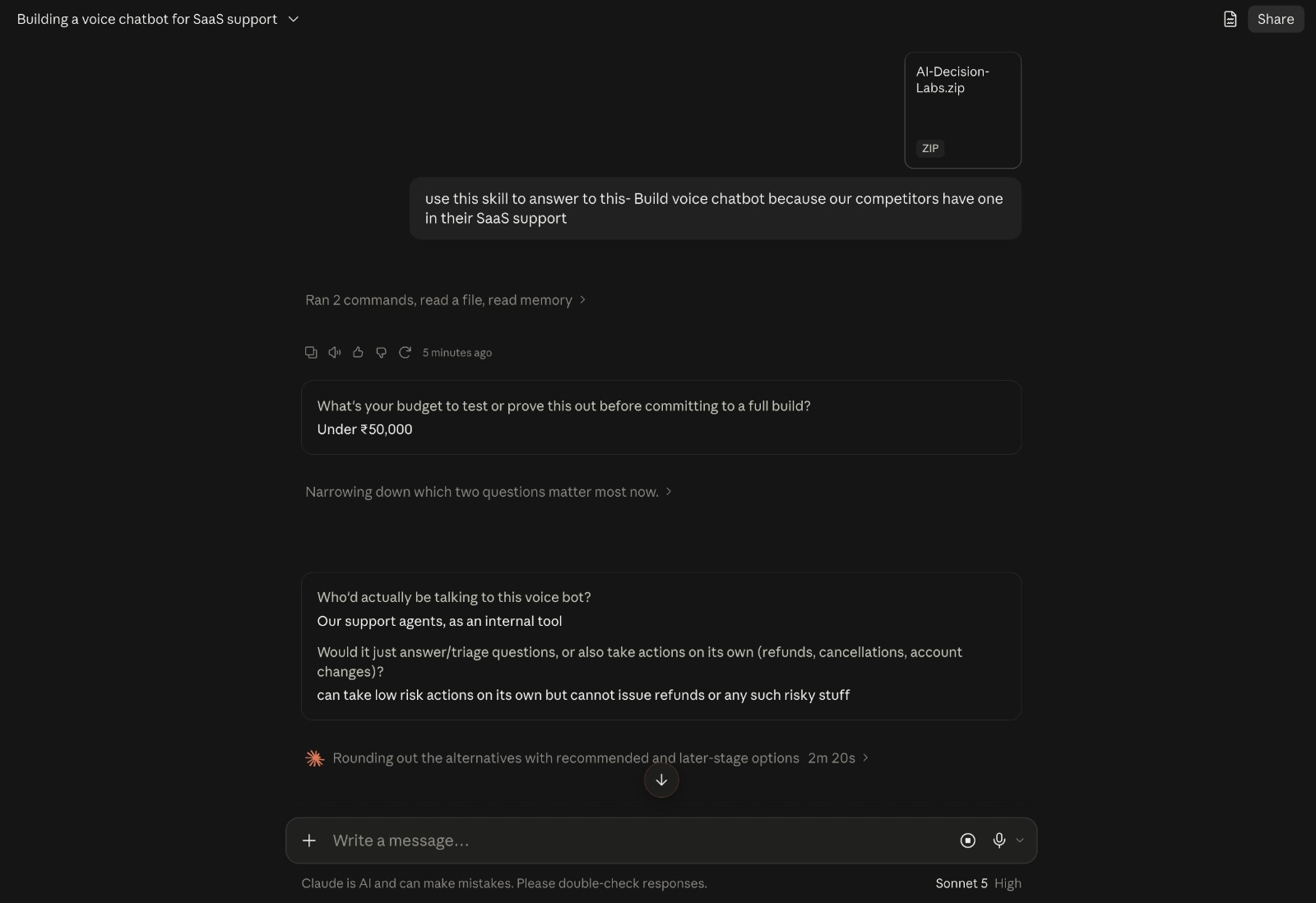
The framework recommends the lowest sufficient architecture for the job.
A reminder, a classifier, a retrieval answer, a draft, a workflow, and an autonomous action are different products. Each one changes the orchestration, data dependency, evaluation method, risk level, and human review boundary.
Budget shapes the proof path, not the architecture truth. The system first decides what the automation should be allowed to do, then recommends the cheapest credible way to prove whether that path is worth building.
| Capability requested | Likely system path |
|---|---|
| Remind or notify | Rules, scheduler, template workflow |
| Route or assign | Rules first, classifier only if rules break |
| Summarise or draft | Assistive LLM with human review |
| Answer from approved docs | Retrieval-grounded system with source checks |
| Score or predict | Classifier or ML model with labelled history |
| Coordinate bounded steps | Structured AI workflow |
| Take external action | Strict approvals, logs, rollback, narrow permissions |
| Deny, fire, pay, mislead, surveil, or bypass controls | Human-led, blocked, or rejected |
5. Guardrails and evals
The system is designed to stop confident recommendations when the idea is vague, unsafe, overbuilt, or built on assumed evidence.
It checks value, evidence confidence, risk type, autonomy level, user error tolerance, budget path, and whether a simpler system can solve the job first.
| Guardrail | What it prevents |
|---|---|
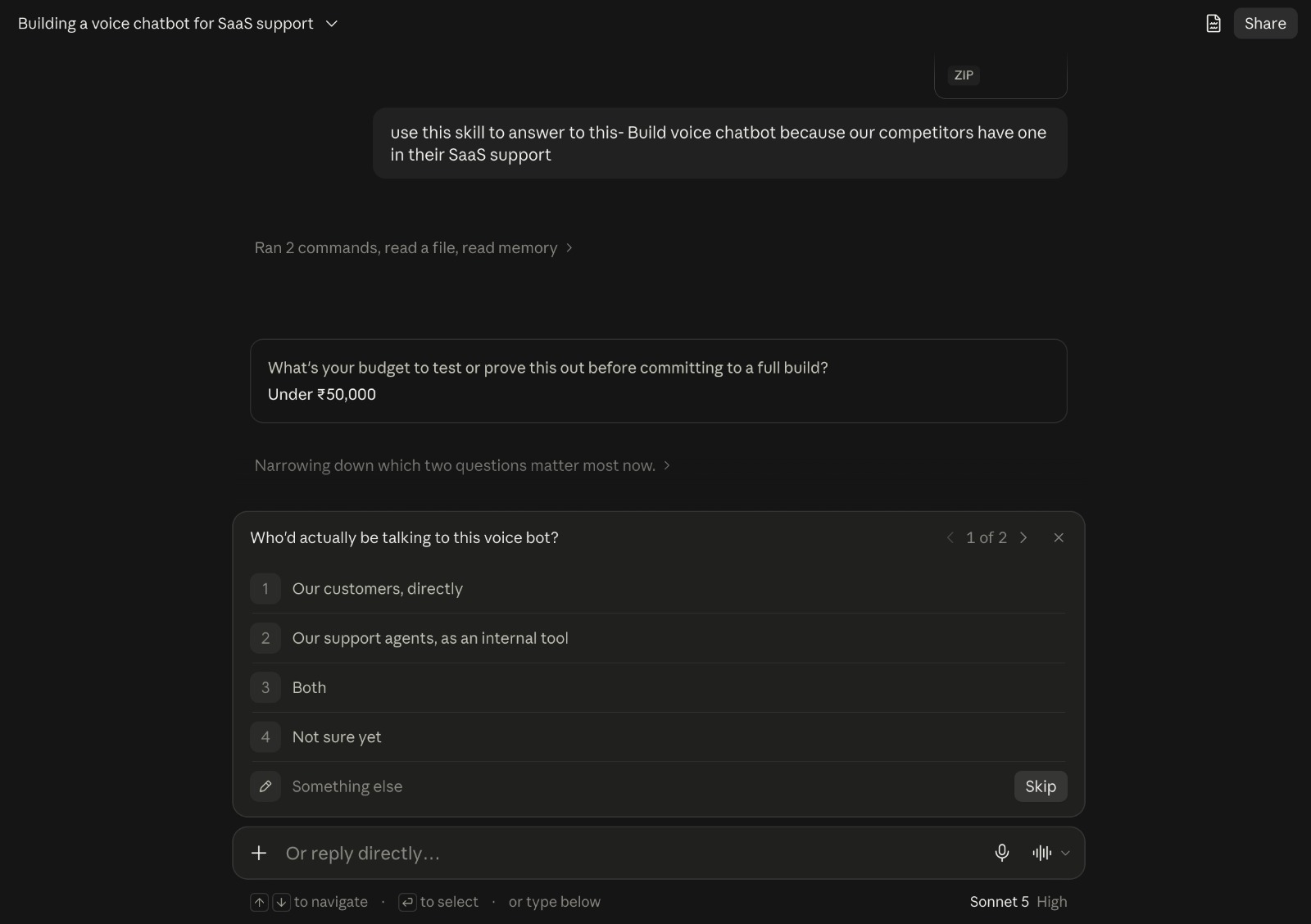
| Budget-first clarification | Stops roadmap planning without knowing the proof budget |
| Value hypothesis check | Stops feasible ideas that do not solve a real enough pain |
| Evidence confidence cap | Stops “eligible” verdicts from guessed data, legal, or infrastructure assumptions |
| Risk archetype classifier | Flags illegal, deceptive, high-stakes, surveillance, financial, medical, and rights-affecting use cases |
| Lowest sufficient architecture | Prevents using LLMs or agents when rules, templates, or SQL are enough |
| Rejection-only mode | Prevents harmful ideas from receiving architecture, roadmap, or testing instructions |
| Content QA | Catches repeated sections, wrong-domain language, and default assumption leakage |
6. Outputs
The prototype generates two outputs because different people inspect the same decision differently.
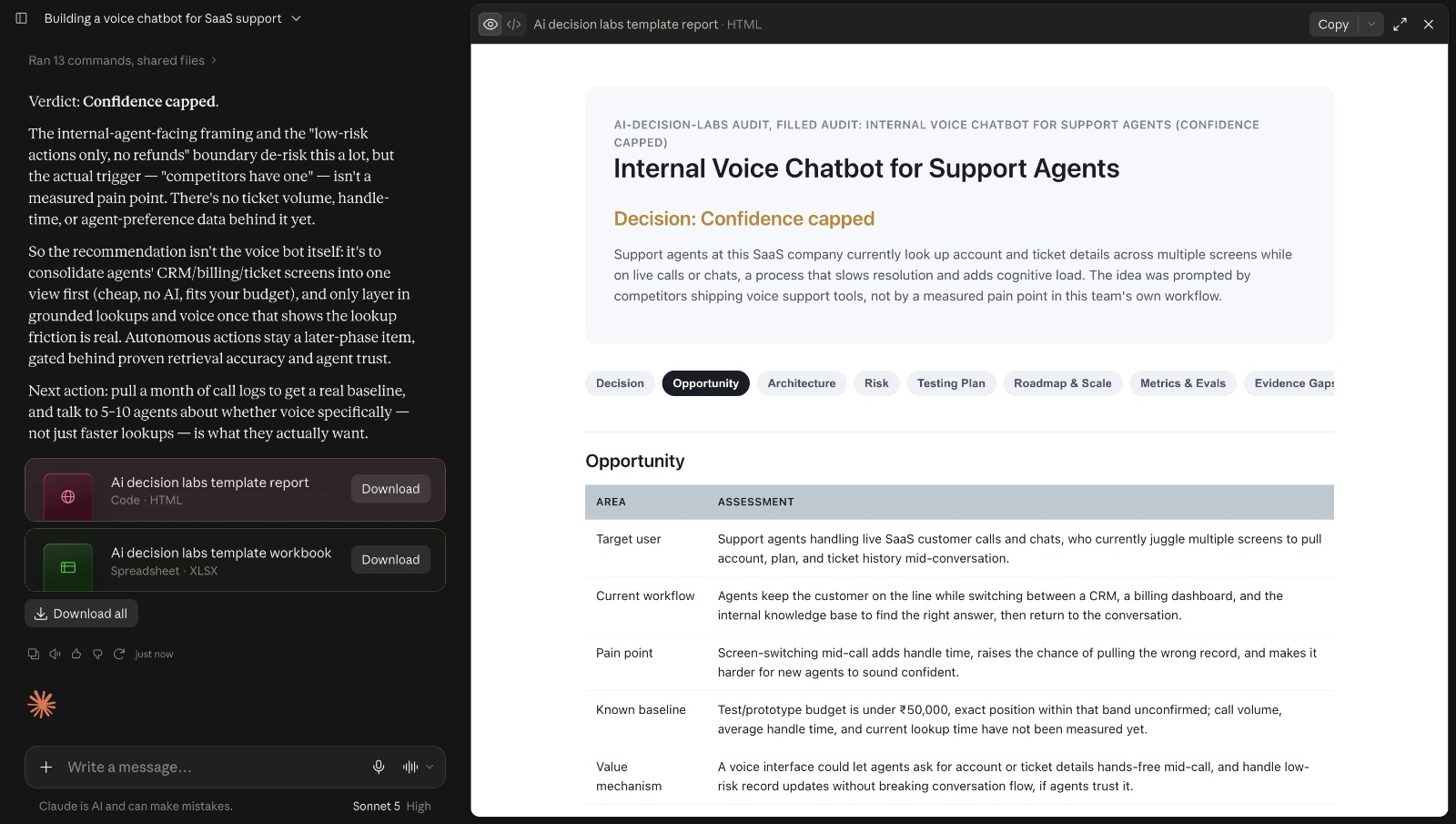
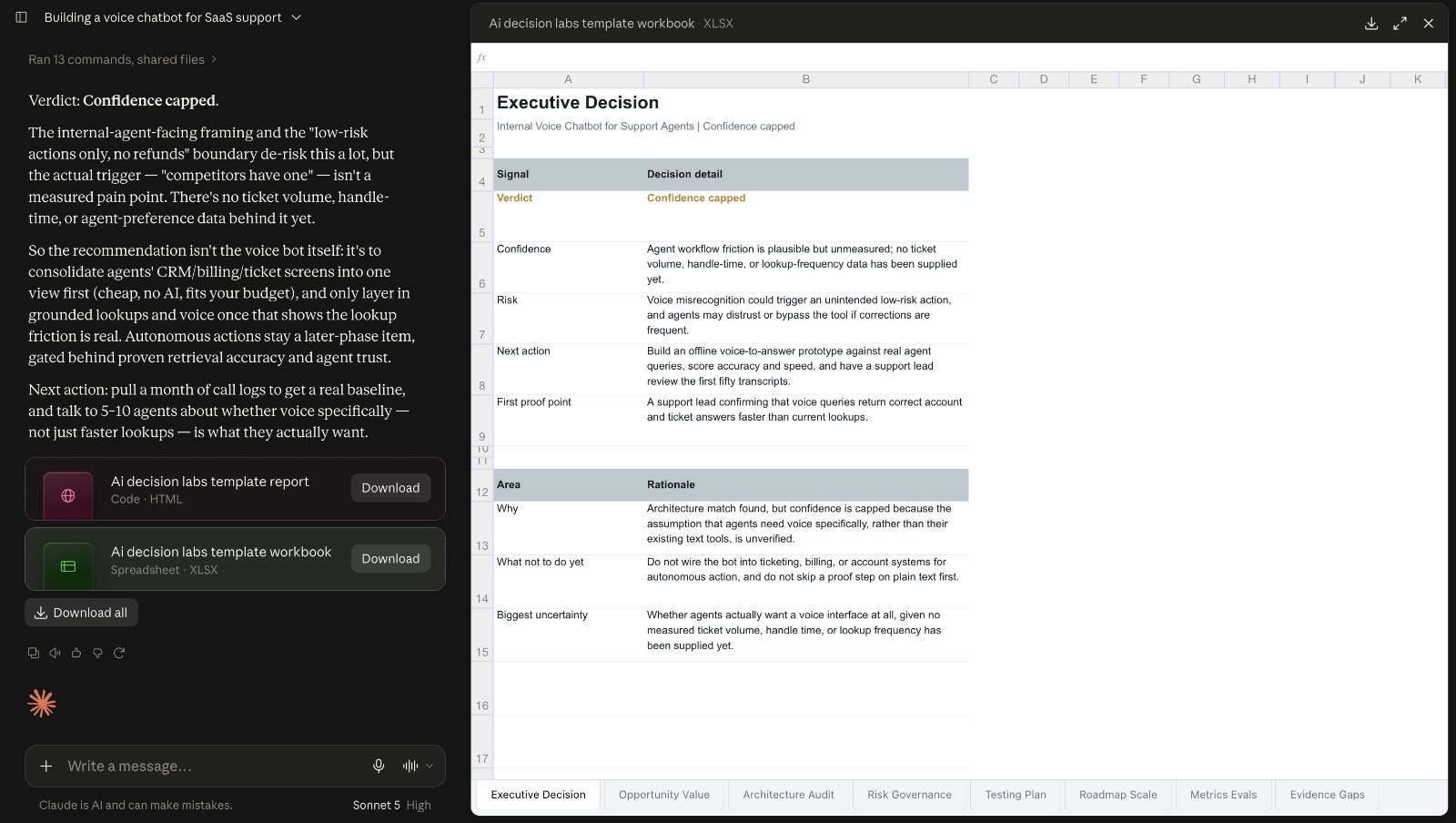
The HTML report helps stakeholders understand the recommendation, reasoning, risks, and next path. The Excel workbook helps analysts, operators, and dev-facing teams inspect assumptions, metrics, evals, roadmap steps, and evidence gaps.
| Output | Audience | Purpose |
|---|---|---|
| HTML report | Founders, PMs, stakeholders | Fast read of the decision and reasoning |
| Excel workbook | Analysts, operators, dev-facing teams | Reviewable assumptions, metrics, evals, roadmap, and gaps |
7. Testing and observations
Testing showed that structure was passing before the product was actually reliable.
The first clean outputs repeated content, gave vague ideas full reports too early, and made some rejected ideas look too close to normal implementation plans. That exposed the main product risk: polished artifacts can create false confidence when the decision logic is weak.
| What testing exposed | Change made |
|---|---|
| Different ideas had the same opportunity text | Added content-specific QA |
| Vague ideas received full audits too early | Added clarification-first routing |
| Rejected ideas still looked like implementation plans | Added rejection-only mode |
| Default sizing assumptions appeared as real value | Disabled value sizing unless supported by input |
| Evidence gaps were hidden inside another section | Made Evidence Gaps a separate output area |
| Simple workflows were still getting AI-shaped treatment | Added simpler-approach routing |
| Architecture could look valid on assumed data | Added evidence confidence caps |
| Feasible ideas could still lack user value | Added value hypothesis checks |
8. Tradeoffs
| Tradeoff | Decision |
|---|---|
| Transferable framework over another AI dashboard | The value is the logic, so it should travel across tools, teams, and use cases. |
| Clarification before instant output | More friction is acceptable when the alternative is a confident report built on missing context. |
| Let the product say no | A product that protects budget and risk has to reject bad ideas, even if the user came for validation. |
| Fixed gates over fully freeform AI judgement | Risk, autonomy, and evidence rules need consistency before any polished recommendation is generated. |
9. My moat
AI Decision Labs gives users a logical answer to what architecture is feasible, how much automation the problem deserves, and what proof is needed before spend.
The moat is the framework’s ability to evolve. It can absorb new architecture patterns, new model costs, new risk cases, specialist feedback, and user-specific constraints without turning into another one-off paid stress-test tool.
It is also designed against agreement bias. The system can simplify, pause, cap confidence, or reject instead of validating every AI idea.
| Moat layer | Why it matters |
|---|---|
| Architecture feasibility logic | Gives a practical system path, not only a score |
| Lowest sufficient architecture | Saves users from testing oversized solutions |
| Personalised constraints | Budget, risk, data, and proof path can adapt to the user’s reality |
| Reusable framework | Can be used across many ideas without starting from zero every time |
| No-agreement design | The product is allowed to say the idea is weak, unsafe, or not worth AI |
| Actionable roadmap | Converts the decision into next steps, not just analysis |
10. Market risks and failures
The biggest market risk is that teams skip the framework and go directly to an AI specialist, consultant, or engineer.
That route can be deeper, but it is expensive, dependent on individual judgement, and difficult to repeat across many ideas. AI Decision Labs works as the first-pass decision layer before specialist spend.
| Risk | Why it matters | Response |
|---|---|---|
| Users skip it for an AI specialist | Specialists feel safer for high-stakes decisions | Position the product before specialist spend, not against specialists |
| Consultant planning is deeper | Custom experts can produce richer plans | Make the framework faster, cheaper, repeatable, and editable |
| Users want validation | Some users dislike being told no | Make budget protection the value, not agreement |
| Weak inputs create weak outputs | Ideation-stage data is often guessed | Use evidence confidence caps and visible gaps |
| Generic reports kill trust | Repetition makes the system feel fake | Keep content QA and wrong-domain checks |
| Architecture assumptions age quickly | AI tooling and costs change fast | Version the framework and update rules over time |
11. GTM launch plan
The initial ICP is founders, operators, product teams, and AI consultants who want AI in a product or workflow, but do not know how much automation is needed, where it should sit, what it may cost to prove, and whether the upside justifies the build.
The first wedge is not a broad SaaS launch. It is a targeted proof campaign around one pain: “Before you spend on an AI build, run the decision once.”
Launch motion
| Step | Channel | Action | Success metric |
|---|---|---|---|
| 1 | Product Hunt | Shortlist startups with 10 to 50 employees building AI or workflow-heavy products | 50 qualified leads |
| 2 | Cold DM founders, PMs, operators, and AI consultants with a free first audit | Reply rate | |
| 3 | Free audit | Run one idea through the framework and send the output | Audit completion rate |
| 4 | Instagram UGC | Post short AI automation teardown reels from a new account | Saves, shares, inbound DMs |
| 5 | Public teardowns | Compare rules vs RAG vs workflow vs agent vs no-go decisions | Qualified inbound interest |
| 6 | Paid ads | Test only after organic messaging converts | Cost per completed audit |
Pricing architecture
| Tier | Includes | Buyer question |
|---|---|---|
| Tier 1: Decision Layer | Decision, architecture recommendation, opportunity analysis | Is this worth exploring? |
| Tier 2: Risk Layer | Tier 1 plus risk gates and evals | Can we test this safely? |
| Tier 3: Scale Layer | Tier 2 plus evidence gaps, testing plan, scaling roadmap, and proof path | What proof earns serious investment? |
Metrics I would track
| Metric | Why it matters |
|---|---|
| Cold DM reply rate | Tests whether the problem framing lands |
| Free audit completion rate | Tests whether users trust the process enough to submit an idea |
| Audit-to-paid conversion | Tests willingness to pay for the framework |
| Time to first paid user | Tests GTM speed |
| Repeat audits per user | Tests whether this is a one-time curiosity or repeated workflow |
| Simpler-path acceptance rate | Tests whether users value being told not to overbuild |
| No-go acceptance rate | Tests whether the product can say no without losing trust |
12. Working proof
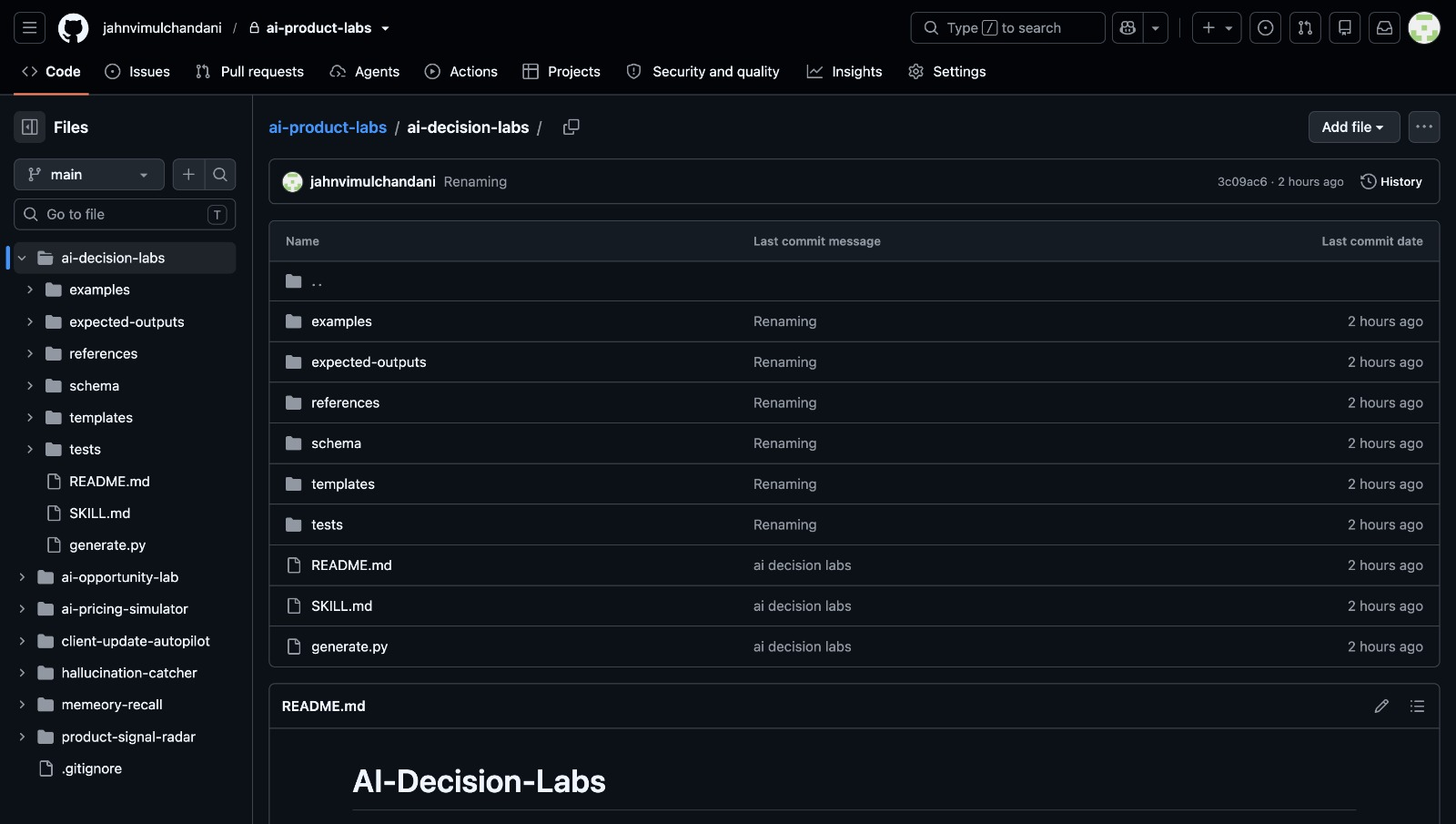
The V1 skill is live as a working repository with schema, templates, examples, tests, and generated outputs.
The gallery below shows a sample clarification, automation boundaries, generated HTML report, Excel workbook, and the private repository structure. These are working examples, not evidence of adoption or commercial results.
The current focus is improving the logic until every output feels specific to the idea, not generated from a generic template.
Conclusion
Adding AI does not create a moat.
Choosing the right automation boundary, architecture, and proof path might.